

How to open a company in Paraguay
A guide for Brazilian business owners
If you intend to genuinely operate in Paraguay, with a bank account, employees, contracts and international remittances, the right vehicle is the privately held Sociedad Anónima (S.A., corporation). This guide explains why, who needs Paraguayan documents, the steps in the order they happen, how much it costs and which taxes the company pays.
Download this guide as a PDF ↓To save or forward. The full guide is right below.
What's left for the owners: Brazil × Paraguay
A mid-sized manufacturer with heavy use of energy and imported raw materials, 20 employees, 2 partners and revenue of R$ 500 thousand per month. The same operation, with the same salaries and the same costs, set up in Brazil and in Paraguay.
In Paraguay, the partners keep 4.0 times more. Taxes and contributions take 33.3% of revenue in Brazil and 4.2% in Paraguay.
Where every R$ 100 of revenue goes (%)
- Imported raw materials
- Energy
- Staff
- Labor risk
- Other operating costs
- Taxes and contributions
- Left for the 2 partners
Hypothetical case, deliberately set at opposite extremes. In Brazil, the company is under the regime that leaves the least for the partners and provisions for the full labor risk; in Paraguay, it is approved under the maquila regime and uses the applicable benefits, with the partners residing in the country. Each activity has its own costs, rates and classifications, and the actual result depends on the specific case. The line-by-line calculation is in the tax section, and the criteria are at the end of the guide.

Why the S.A. is the choice for those who will operate
Paraguayan law offers three main types of company: the Sociedad Anónima (S.A., corporation), the Empresa por Acciones Simplificada (EAS, simplified joint-stock company) and the Sociedad de Responsabilidad Limitada (S.R.L., limited liability company). All three protect the partners' personal assets, but they do not carry the same weight with banks, clients and government agencies.
The S.A. is the standard vehicle for operations with foreign revenue, international contracts and a structured banking relationship. It is the best accepted by Paraguayan banks, and the declared share capital weighs in the assessment of transaction volume. The EAS, created to simplify the opening of smaller businesses, meets more resistance when opening an account and moving international funds from the start.
Choose the right vehicle from day one. Changing the corporate type once the company is up and running is a laborious process. A structure that is correct on paper but stalls at the account opening or the first remittance does not serve its purpose.
The S.A. requires at least two shareholders. In most cases, the second shareholder is a family member, such as a spouse or child. When that is not possible, a shareholder with a minimal stake is enough, just to meet the legal requirement, and you keep full control of the company.
The EAS also has its place. Besides serving smaller businesses, it is widely used as a shareholder of other companies, including an S.A., in asset protection and succession planning structures.
| S.A. · recommended | EAS | S.R.L. | |
|---|---|---|---|
| Profile | Operations with employees, banks, contracts and expansion | Smaller businesses and holdings in other companies | Mid-sized projects |
| Banking relationship | Good acceptance; share capital weighs in the assessment | More resistance in practice | Intermediate |
| Partners | 2 or more | 1 or more | 2 to 25 |
| Legal minimum capital | Not required; set in the bylaws according to the operation | Not required | Not required |
| How it is incorporated | Public deed | Online, through SUACE | Public deed |
| Management | Board of directors, with a síndico (statutory auditor) | Legal representative | Managers |
| Liability | Limited to subscribed shares | Limited to contributions | Limited to quotas |
Source for the legal characteristics: Guía para Inversionistas Extranjeros, SUACE/MIC (2025).
Who needs Paraguayan documents
A Brazilian can be a shareholder of a Paraguayan company without living in Paraguay. Whoever manages the company and represents it before the tax authority, however, needs a Paraguayan cédula (Paraguayan ID), which is issued after residency.
| Role in the company | Needs Paraguayan residency and cédula? |
|---|---|
| Shareholder | Not mandatory, but we recommend having Paraguayan documents. |
| Director (management of the S.A.) | Yes, radicación (residency) in Paraguay. |
| Síndico (statutory auditor of the S.A.) | Yes, radicación (residency) in Paraguay. |
| Legal representative before the DNIT | Yes, a cédula issued in Paraguay, for any type of company. |
Sources: DNIT, documents for RUC registration; RSA Abogados (2023).
That is why we recommend that the partners obtain their Paraguayan personal documents before incorporating the company. With them, tax registration, account opening and dealings with government agencies become simpler. Those who prefer not to reside in Paraguay can appoint a resident legal representative, whether a partner or not, with powers limited to receiving official communications and no authority to manage the business.
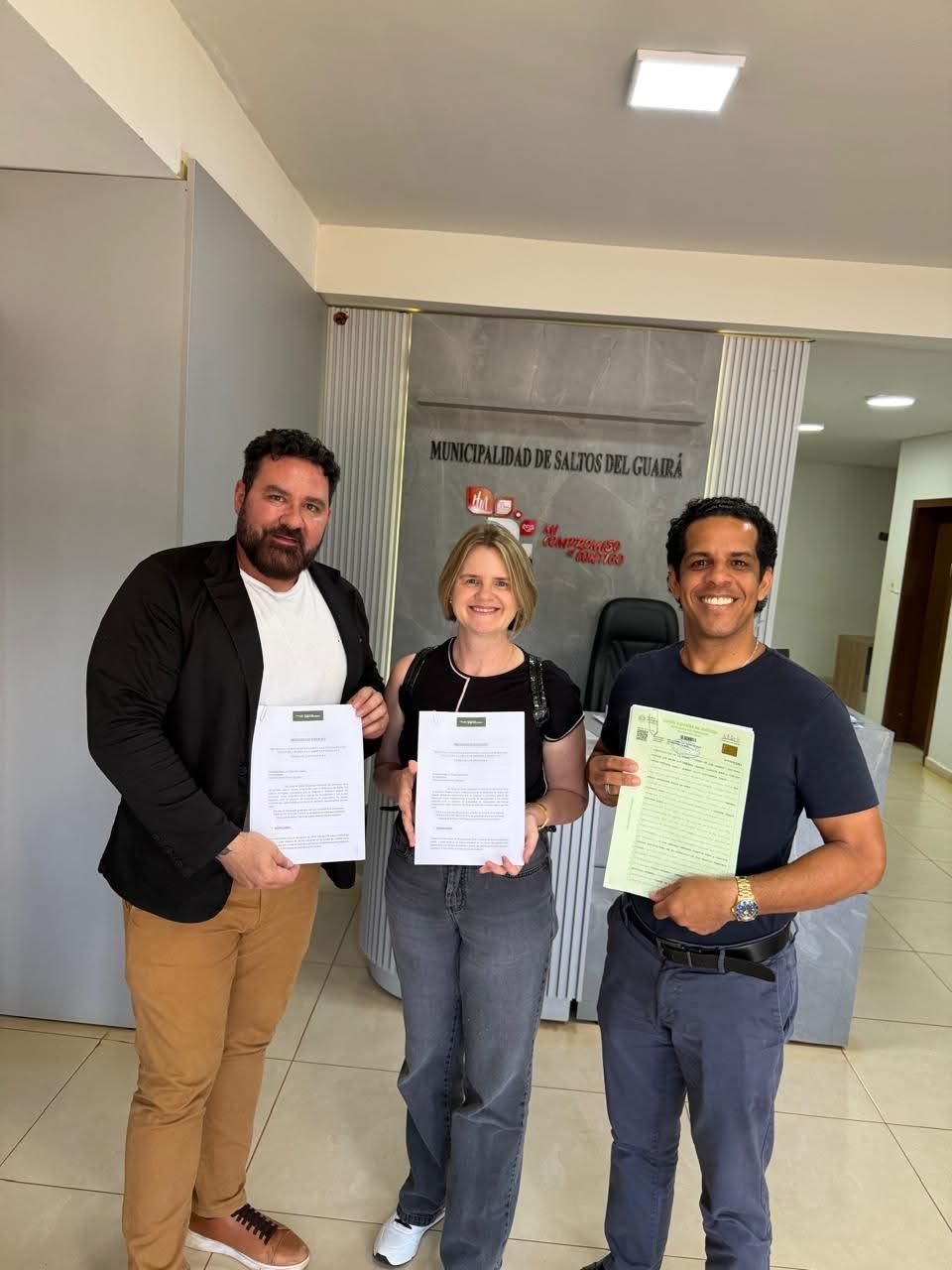
Personal documents have a guide of their own: Personal documents and residency in Paraguay.
The path, in four phases
Once your personal documents are ready, incorporating the S.A. takes 30 to 45 days on average. Next come tax registration and the permits to start operating.
- 1PreparationPersonal documents, shareholders, capital and boardDocuments: 15 to 150 days, depending on the type and demand
- 2IncorporationBylaws, public deed, registration and publication30 to 45 days
- 3Tax registrationRUC with the DNIT and beneficial owner registrationRight after registration
- 4Authorization to operateMunicipal license, electronic invoicing, IPS and bank accountDepending on the activity
1. Preparation
Residency, cédula (Paraguayan ID), personal RUC (tax ID) and, if desired, a Paraguayan driver's license. It requires an in-person visit for biometrics and photo. From Brazil, only two documents need to be apostilled at a notary office (cartório): the birth or marriage certificate and the Federal Police criminal record certificate.
2. Incorporation
The deed is executed by a public notary (escribano), but the work that defines the outcome comes before it. The articles of incorporation are studied and designed case by case: what you intend to do in Paraguay, the business's current stage and its ideal future stage. As a result, the bylaws are born ready for the activity and to access every possible benefit and advantage, including incentive regimes.
Planning ahead avoids rework and future costs from bylaw amendments, and brings speed, security, suitability, savings and efficiency. After signing, which can be done on the same visit as picking up the personal documents, the company is registered with the Dirección General de los Registros Públicos, with publication in a newspaper.
3. Tax registration
Registration of the company in the DNIT's RUC (tax ID), the tax registry equivalent to Brazil's CNPJ. The company also reports who its actual owners are to the Dirección General de Personas y Estructuras Jurídicas y Beneficiarios Finales (Ley 6.446/2019), within 45 business days after registration, and keeps this information up to date.
4. Authorization to operate
Premises license and business license (patente comercial) at the Municipalidad, authorization as an electronic invoice issuer in SIFEN, and registration with the IPS (social security) and the Ministry of Labor before hiring. For the bank account, banks ask for the bylaws, shareholder information, proof of the source of funds and, increasingly, a tax clearance certificate or the latest IVA (VAT) returns. Regulated activities may require their own authorizations.

How much it costs
The amounts below are OMNI HOLD's reference prices as of October 2026 to open and maintain a privately held S.A. In the example, the company is incorporated with share capital of US$ 50,000.
| Item | Reference amount |
|---|---|
| Administrative, notary, filing agent and accounting costs (about 3.5% of share capital) | approximately US$ 1,750 |
| Fees for overseeing the incorporation | US$ 1,000 |
| Estimated total to open | approximately US$ 2,750 |
| Municipal license fee | varies by municipality |
Share capital is not a cost. The US$ 50,000 is the company's capital in the example, not the amount paid to open it. Under these conditions, the opening cost is around US$ 2,750.
| Service | Monthly reference |
|---|---|
| Resident legal representative, when required | from US$ 100 |
| Accounting, legal advisory and registered tax address | from US$ 550 |
The monthly reference assumes share capital of US$ 50,000 and up to 10 employees. Amounts are non-binding; the final proposal depends on the activity, the number of partners, the payroll and the expected transaction volume.
Does your project have the same features? Answer six quick questions and see the recommended next step for your case.
Take the free diagnostic →Taxes: 10% on profit
Under the general regime, the company pays 10% income tax on profit (IRE). When profit is distributed, the shareholder pays an additional 8% IDU if resident in Paraguay, or 15% if not. The difference is one more reason to include residency in the planning from the start.
Two points that weigh in your favor. A resident director who receives compensation from the company pays no personal income tax up to G. 80 million per year, about R$ 75 thousand. Above that, the rate is 8% to 10%, calculated on net income: personal and family expenses in the country, such as housing, food, health, education and leisure, are deducted first. In Brazil, full exemption only goes up to R$ 5 thousand per month, about R$ 60 thousand per year, and the rate reaches 27.5%, with few deductions. And, for a company approved under the maquila regime, the operation pays a single 1% tax on sales, and maquila profits are exempt from IDU upon distribution (Ley 7.547/2025, arts. 37 and 38).
| Tax | Rate | On what |
|---|---|---|
| IRE · business income | 10% | Company profit (Ley 6.380/2019) |
| IDU · profit distribution | 8% resident · 15% non-resident | Dividends paid to shareholders |
| IVA (VAT) | 10% general · 5% reduced | Sales and services |
| IPS · employer share | 16.5% | Salaries |
| Maquila · special regime | 1% | Single tax on sales; maquila profits exempt from IDU (Ley 7.547/2025) |
Sources: DNIT (IDU), DNIT (IRP, G. 80 million), Ley 6.380/2019 and Ley 7.547/2025.
Maquila is not automatic: the company needs an approved program, and eligibility depends on the activity and the operating model.
The simulation, line by line
The table below details the simulation presented at the beginning of the guide. Amounts are monthly, in reais; in Paraguay, the same amounts in reais were converted at G. 1,071 per real wherever the local rule uses guaraníes.
| Monthly, in R$ | Brazil | Paraguay |
|---|---|---|
| Revenue | 500,000 | 500,000 |
| Imported raw materials (CIF value, freight and import expenses) | 82,240 | 85,600 |
| Import duty (35%) | 28,000 | zero (maquila) |
| Electricity (net of credits) | 37,208 | 16,667 |
| Staff: salaries, 13th-month salary or aguinaldo, vacation, FGTS and benefits | 93,400 | 69,842 |
| Payroll charges (INSS, RAT and third parties · IPS) | 22,790 | 10,230 |
| Labor risk (FGTS penalty or severance, notice period, reserve for lawsuits) | 6,453 | 6,150 |
| Other operating costs | 51,971 | 51,971 |
| Net ICMS | 54,738 | not applicable |
| Net PIS and COFINS | 30,654 | not applicable |
| Single maquila tax (1% on sales) | not applicable | 5,000 |
| Management fee (pró-labore) of the 2 partners | 20,000 | 20,000 |
| Employer contribution on the pró-labore | 4,000 | 3,300 |
| Profit before income tax | 68,547 | 231,240 |
| IRPJ and CSLL · IRE | 21,306 | exempt (maquila) |
| Profit distributed to the partners | 47,241 | 231,240 |
| Tax on dividends | zero (below the threshold) | exempt (maquila) |
| Net pró-labore of the 2 partners (after social security and personal income tax) | 14,966 | 17,704 |
| Left for the 2 partners per month | 62,207 | 248,944 |
| Left for the 2 partners per year | 746,481 | 2,987,328 |
| Taxes and contributions as a share of revenue | 33.3% | 4.2% |
In Brazil, the actual-profit regime (lucro real) left less for the partners than the presumed-profit regime (lucro presumido) (under presumed profit, the partners would keep R$ 69,856 per month), which is why it was the regime used. Full criteria at the end of the guide.

And the Brazilian side
Anyone who remains a tax resident of Brazil reports their stake in the Paraguayan company there, and the profit of the foreign subsidiary may be taxed in Brazil, depending on the structure (Law 14,754/2023). For those who stay in Brazil, the advantage lies in the operation: cost, energy, labor, logistics, access to Mercosur and incentives such as maquila.
Having Paraguayan residency and a cédula does not, on its own, end your tax residency in Brazil. Anyone who actually moves needs to file a definitive departure with Brazil's Federal Revenue Service and, from then on, is subject to personal taxation in Paraguay. Both situations call for upfront design, and that is exactly what the feasibility study answers.
How OMNI supports you

OMNI HOLD is a Paraguayan sociedad anónima headquartered in Salto del Guairá, and its partners have been operating in Paraguay for more than 10 years. We handle personal documents, incorporation of the S.A., registrations, accounting and legal advisory, with a physical presence in the country and Brazilian and Paraguayan lawyers.
The work begins before the opening: understanding what you intend to develop in Paraguay, how the operation will work and whether you will keep living in Brazil. From there, there are two paths.
Every month, the Business Mission welcomes business owners in Salto del Guairá for site visits, meetings with institutions and conversations with people who already operate on the other side of the border.
The team assesses the case and recommends the right service: an orientation meeting, execution of the opening or a feasibility study.
Frequently asked questions
Can a Brazilian open a company in Paraguay without living there?
You can be a shareholder without living in Paraguay. To run and represent the company, you need a Paraguayan cédula, or you can appoint a resident legal representative.
Why the S.A. and not the EAS?
The EAS is faster to open, but it meets more resistance from banks. To operate with employees, contracts and international remittances, the S.A. avoids having to change the corporate type later.
The S.A. requires two shareholders. What if I want to be the sole owner?
The second shareholder is usually a family member. If that is not possible, a shareholder with a minimal stake is enough to meet the legal requirement, and control remains entirely yours.
How long does it take?
Personal documents take 15 to 150 days, depending on the type, and the timeline may be longer due to high demand. Once they are ready, incorporating the S.A. takes 30 to 45 days on average.
Is the US$ 50,000 in the example the cost to open the S.A.?
No. It is the share capital used in the example. Under these conditions, the opening cost is around US$ 2,750, plus the municipal fee.
Is there a minimum capital requirement?
The law does not set a minimum. Capital is defined in the bylaws according to the operation and weighs in the bank's assessment.
Does opening the company guarantee a bank account?
No. The bank reviews the company's documents, the shareholders, the activity, the source of funds and the expected transaction volume. A well-built structure makes that review easier.
What is the tax on profit?
10% IRE. When distributed to the shareholder, an additional 8% (resident) or 15% (non-resident) IDU. Under maquila, a single 1% tax on sales, with profits exempt from IDU.
Can any company use maquila?
Not automatically. You need an approved maquila program, and eligibility depends on the activity and the operating model.
Can I keep my company in Brazil and operate in Paraguay?
Yes. The structure just needs to take into account the rules of both countries, especially for transactions between companies in the same group, remittances and profit distribution.
Can I get to know Paraguay before deciding?
Yes. Every month, the Business Mission welcomes business owners in Salto del Guairá to see the infrastructure, the institutions and the opportunities up close.
How does the Business Mission work?
It is four days in Salto del Guairá, with talks, site visits to customs and the industrial hub, meetings with local institutions and conversations with business owners who already operate in Paraguay. At the end, participants receive a certificate. Program, dates and registration at missaoparaguay.com.br.
Which Brazilian documents do I need for my Paraguayan documents?
Only two need to be apostilled at a notary office (cartório) in Brazil: the birth or marriage certificate and the Federal Police criminal record certificate. The complete step-by-step is in the guide Personal documents and residency in Paraguay.
Do I need to move to Paraguay to get the cédula?
No. Paraguay does not require you to live in the country to obtain and keep the documents: all it takes is an in-person visit for biometrics and photo, a return trip to pick them up and periodic visits to the country. Those who decide to actually move and file their tax departure from Brazil gain additional advantages, such as Paraguayan personal taxation, and that path is part of the planning.
What is the next step for your project?
OMNI Setup Diagnostic
Six quick questions about your activity, the stage of your project and your timeline. At the end, you see the recommended path: Business Mission, orientation meeting, support for the opening or feasibility study.
Take the free diagnostic →Already have a defined project? Talk directly to the team

WhatsApp support
Point your camera at the code or click the button below.
Start a WhatsApp chat →+55 62 98444-9688
Our channels
 OMNI HOLD
 Business Mission
 Câmara de Comércio Brasil-Paraguay
 Telegram channel
 WhatsApp channel
 WhatsApp community group
 OMNI Instagram
 Chamber Instagram
 YouTube
 LinkedIn
Simulation criteria
The simulation compares the same hypothetical company at two extremes: in Brazil, in the scenario that leaves the least for the partners; in Paraguay, with every benefit the law allows. The criteria below are open to critique, and anyone who wants to discuss a number can talk to the OMNI team.
Common assumptions
Revenue of R$ 500 thousand per month, or R$ 6 million per year. Twenty employees with an average salary of R$ 3 thousand and two partners with a management fee (pró-labore) of R$ 10 thousand each. Raw materials imported from a country with no trade agreement, with a CIF value of R$ 80 thousand per month (16% of revenue), and an energy bill of R$ 50 thousand per month in Brazil (10% of revenue), typical of an activity that uses a lot of both. In Brazil, the company has an operating profit of 15% of revenue before labor risk provisions, the market standard for manufacturing; the other operating costs (rent, maintenance, domestic inputs, freight, administration and sales) were calculated to close that margin, total R$ 51,971 per month and are repeated unchanged in Paraguay. Revenue is the same in both countries; taxes the buyer may pay when importing are left out of the company's calculation.
Brazil
Tax regime. The Simples Nacional does not apply, because revenue exceeds R$ 4.8 million per year. We calculated the presumed-profit regime (lucro presumido), already including the 10% increase in the presumption on revenue above R$ 5 million per year (Supplementary Law 224/2025), and the actual-profit regime (lucro real); actual profit left less for the partners and was the one adopted. Under actual profit: IRPJ of 15% plus a 10% surcharge on profit above R$ 20 thousand per month, CSLL of 9%, PIS and COFINS of 9.25% with credits on imports, energy and half of the other costs. ICMS of 18% on sales, with a credit for the ICMS on imports and energy. IPI was treated as neutral (the debit on sales offsets the credit on purchases), as were the 2026 test-phase CBS and IBS, since they are creditable.
Imports. Import duty of 35%, the ceiling Brazil may apply to manufactured goods under its WTO commitments, used here as the worst case; for most raw materials the effective rate is lower. PIS and COFINS-import of 11.75%, AFRMM of 8% on ocean freight (estimated at 10% of the CIF value) and customs expenses of 2%.
Payroll. Employer INSS of 20%, RAT of 3% multiplied by the maximum FAP of 2.0 (6%), third-party contributions of 5.8% (salário-educação, Senai, Sesi, Sebrae and Incra) and FGTS of 8%, all on salary, 13th-month salary and vacation with the constitutional one-third bonus. Collective bargaining benefits (meal voucher and net transportation voucher) of R$ 800 per employee per month.
Labor risk. Full provision for the 40% penalty on FGTS deposits; paid notice period of one salary, with FGTS, for a 40% annual turnover; and a reserve for labor lawsuits of 3% of the annual payroll, estimated from the amount paid by the Labor Courts to claimants in 2025 (R$ 50.6 billion), in proportion to the country's formal wage bill, plus court costs and attorney fees.
Partners. Employer contribution of 20% on the pró-labore; partner INSS of 11% up to the cap and income tax under the 2026 table, at the 27.5% rate (above R$ 7,350 per month there is no reduction). Dividends stay below R$ 50 thousand per month per partner and each partner's annual income stays below R$ 600 thousand, so there is no 10% withholding and no minimum tax (Law 15,270/2025).
Paraguay
Maquila. Company approved under the maquila regime, exporting its output: single 1% tax on sales, exemption from IRE and from IDU on maquila profits (Ley 7.547/2025, arts. 37 and 38) and entry of raw materials under temporary admission, with no import duty or IVA. We added 5% of the CIF value for additional freight to Paraguay, which is landlocked, and 2% in clearance expenses.
Energy. One third of the Brazilian bill. A regional survey published in July 2026 ranks Paraguay's industrial tariff as the lowest in Latin America, at about 40% of Brazil's; one third is the assumption adopted for energy-intensive activities.
Payroll. Same salaries in reais. Employer IPS of 16.5% on salary and vacation; aguinaldo of one salary per year; vacation of 12 business days per year; family allowance estimated at one child per employee.
Labor risk. Full provision for dismissal severance of 15 days' salary per year worked; preaviso (notice) of 45 days for the same 40% turnover; and a reserve for lawsuits of 1% of payroll.
Partners. Conservative assumption of IPS contributions also on the pró-labore (16.5% employer and 9% partner). The partners are directors residing in Paraguay: personal income tax applies to net income, after deducting personal and family expenses in the country, estimated at R$ 6 thousand per month per partner, in brackets of 8% to 10%.
What the simulation does not show
The Paraguay result assumes partners with tax residency in the country, that is, with a definitive departure from Brazil. Anyone who remains a tax resident of Brazil may have the Paraguayan company's profit taxed in Brazil, depending on the structure (Law 14,754/2023), and the design changes. The simulation also does not include the investment in relocating, the learning curve of the new operation or the particularities of each sector, which are covered in the feasibility study.
Sources consulted
- Guía para Inversionistas Extranjeros, SUACE/MIC (May 2025)
- Preguntas frecuentes EAS, SUACE
- Documentos requeridos para la inscripción en el RUC, DNIT
- IDU, DNIT
- IRP: annual threshold of G. 80 million, DNIT
- Ley 7.547/2025, Régimen de Maquila, Biblioteca y Archivo Central del Congreso
- Ley 6.446/2019, Biblioteca y Archivo Central del Congreso
- Extranjeros en Paraguay: apertura de sociedad anónima, RSA Abogados (2023)
- Simulation: 10% increase in presumed profit (Supplementary Law 224/2025), Contábeis
- Simulation: 2026 personal income tax (IRPF) table and Law 15,270/2025, Jettax
- Simulation: 35% import duty ceiling for manufactured goods (WTO commitment), Lopes Castelo
- Simulation: Labor Courts pay out R$ 50.6 billion in 2025, Revista Oeste
- Simulation: IPS contributions (16.5% employer and 9% employee), Yo Facturo
- Simulation: industrial energy tariff in Paraguay and Brazil, Última Hora (July 2026)
About the author. Paulo Roberto Resende Nascimento is Brazilian, married, a business owner and a lawyer in Brazil, where he practices as a specialist in corporate law and international trade and serves as a court-appointed administrator (administrador judicial). In Paraguay, he is a business owner and has spent more than 10 years helping clients set up in the country. He is a managing partner of OMNI HOLD S.A., the Paraguayan company that offers this guide and the services described in it, with no direct or indirect connection to his professional activity in Brazil. He is a founding member of the Brazil-Paraguay Chamber of Commerce (Câmara de Comércio Brasil-Paraguay), established in 2017, a nonprofit organization of which he is currently vice president.
About this guide. This guide was prepared to meet a need identified by our partner, the Câmara de Comércio Brasil-Paraguay, with the aim of providing concrete, real and well-founded information. Its content brings together what Paraguayan laws and regulations provide, interpreted in light of the real-world activity and practical experience of OMNI HOLD, whose partners have been operating in Paraguay for more than 10 years, and it is up to date as of October 2026. It is for informational purposes only and has no purpose whatsoever of soliciting clients for legal services in Brazil. It does not create rights or obligations, does not establish guarantees and does not replace consultation with and support from qualified and licensed professionals and companies, nor the analysis of the specific case. The amounts are references and do not constitute a proposal.